
2016 Challenge: Smartphones Now vs Smartphones Then
Following the viral 2016 revival trend, A1 decided to go 10 years back to see how the Top 10 of the most selling smartphones has been changing over the years.
For starters, let's recall what the mobile service landscape looked like in 2016. Back then, telecom companies were still using 3G standards, with the goal of covering 97% of the territory of Belarus by the end of the year. The forth-generation technology was only available in Minsk. As for other major cities, the launch of 4G was expected there over the course of the year.
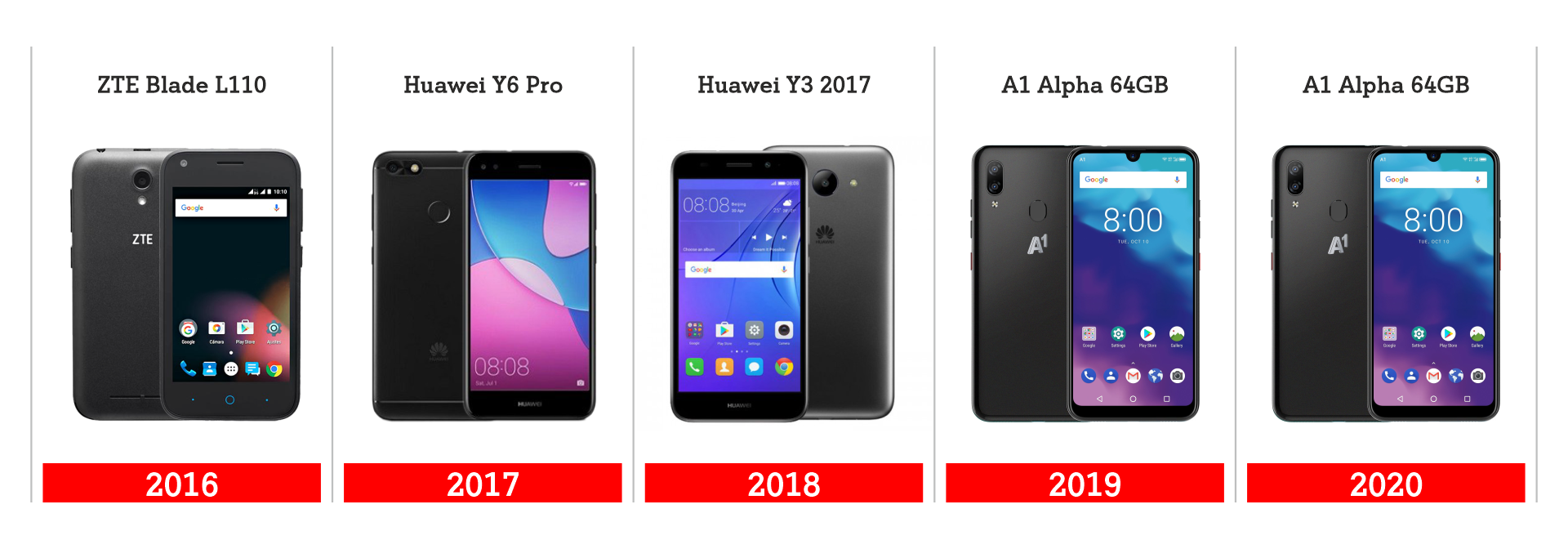
The Top 10 most selling smartphones at A1 stores in 2016 definitely has a nostalgic vibe to it. It features now-forgotten brands (ZTE, HTC, etc.) and devices with underwhelming characteristics. For example, the rating's leader, ZTE Blade L110 offered 1GB of RAM and a 4-inch 480x800 display. It's hard to believe but back then most users were quite happy with these features. The second spot belonged to a more impressive HUAWEI Y6 Pro that boasted an HD display, 2GB of RAM, and 16GB of SSD. The third place was occupied by Samsung Galaxy J1 mini – another simple and affordable device. Interestingly enough, some of the smartphones whose characteristics were quite impressive for the time – such as HTC Desire 626g DS, Samsung Galaxy J7, and Huawei P8 lite – ended up at the very bottom of the Top 10.
In 2017, the Top 3 most selling phones had a push-button mobile phone in the third place. It was ZTE F327S. Indeed, not everyone was ready to switch to touch screens, smart operating systems, and a big variety of apps. The first two places went to the already mentioned Huawei Y6 Pro and Huawei Y3 2017, accordingly.
Another curious fact is that as many as four Xiaomi smartphones made it to the Top 10 most selling devices – Xiaomi Redmi 4X with 32GB and 16GB of SSD, Xiaomi Redmi 4A, and Xiaomi Redmi Note 4. The Chinese brand has never left the Top 10 rating ever since.
The performance of smartphones has been improving as more and more models offered 2GB (or even 3GB) of RAM. Plus, HD and FullHD displays were becoming increasingly common.
The year 2018 brought us smartphones with even more potency. For example, the most powerful HUAWEI P20 lite – No. 2 on the Top 10 – boasted 4GB of RAM, 64GB of SSD, and a 5.84-inch display with a resolution of 1,080x2,280. Plus, it was the first device on the Top 10 list with a double camera setup.
The first place belonged to Huawei Y3 2017, while the third spot went to Xiaomi Redmi 5A.
The breakthrough of 2019 was A1 Alpha – a smartphone released under the A1 brand. By the way, only a year earlier, in 2018, A1 switched to the branding and the name that we all know today. Combining decent characteristics and budget-friendly price, A1 Alpha became the most selling smartphone across A1 stores. The second spot went to Samsung Galaxy A50 with its triple camera setup, high-performance CPU, and great price-quality ratio.
At the same time, wallet-friendly devices with less impressive characteristics also ended up on the Top 10, and not exactly at the bottom. For example, Huawei Y5 Lite ended up the 3rd, while Xiaomi Redmi 6A placed the 4th.
The year 2020 saw a similar situation. A1 Alpha repeated its success, helming the Top 10 of the most selling smartphones at A1 stores. The second place went to the wallet-friendly Xiaomi Redmi 9A. The third spot belonged to the super advanced Samsung Galaxy A51 with a quad camera setup and 4K video recording. By that time, every "respectable" smartphone already had 4GB of RAM and 64GB of SSD, making the manufacturers compete with each other in terms of lens and megapixels.
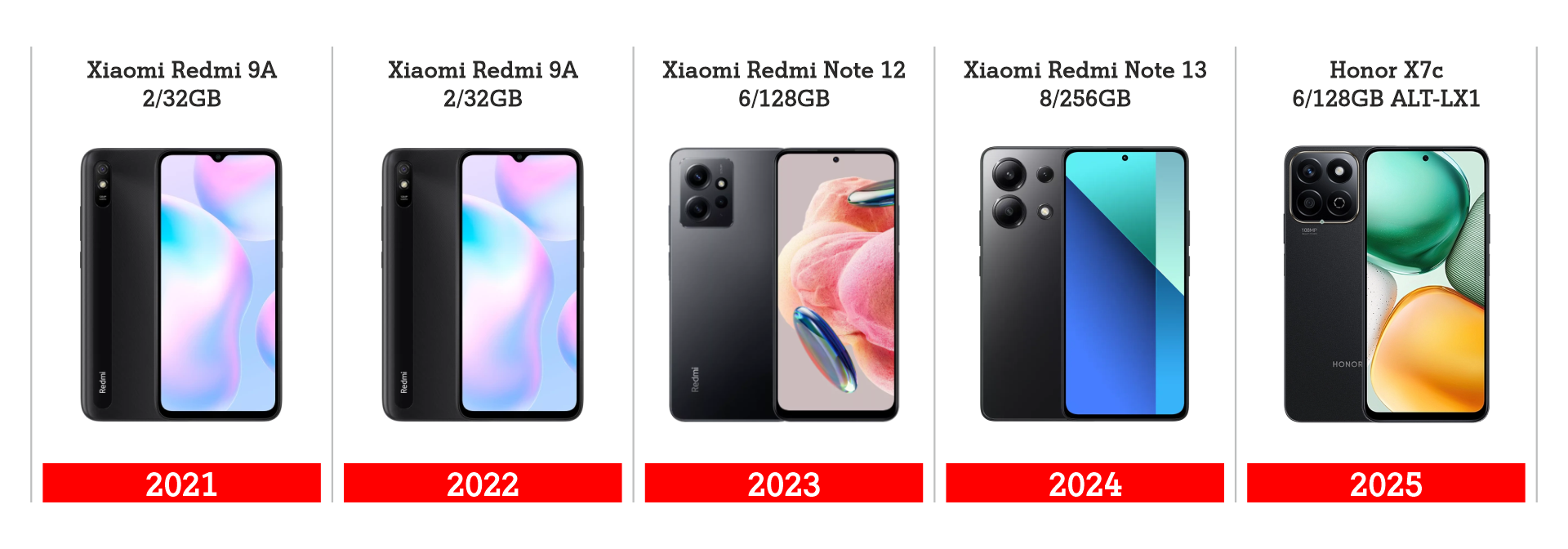
If you bought a smartphone back in 2021, we bet it was a Samsung or a Xiaomi. Needless to say, these two high-tech giants dominated the Top 10 by A1 in 2021. A third and final name on the list was POCO, a Xiaomi sub-brand, with its M3 model. Xiaomi Redmi 9A, Xiaomi Redmi 9T, and Xiaomi Redmi 9 occupied the top 3 places.
In 2022, the first five spots once again went to Xiaomi, with more basic models ending up higher on the list. The rating was helmed by Xiaomi Redmi 9A. Offering 2GB of RAM, 32GB of SSD, and a single 13MP main camera, it was considered basic even back then. The second and the third spots went to a slightly more advanced Xiaomi Redmi C9 and Xiaomi Redmi 10C, accordingly. It looked like consumers were actively replacing their old mobile phones with newer devices. Although inexpensive, they allowed users to benefit from the latest telecom technologies. The average buyer was after a stable mobile Internet connection and smoothly operating messengers, rather than advanced cameras or high-performance gaming CPU. At the same time, some buyers were more demanding and picky as the Top 10 also included Xiaomi Redmi Note 10 Pro — a device that looks edgy even today. Here's a tiny spoiler: in the next year's rating, Xiaomi Redmi Note 10 Pro jumped from the 10th spot right to the 2nd. That's quite an impressive progress!
2023 saw major changes in the consumer demand. At the helm of the Top 10, we could see more advanced devices with solid features, such as Xiaomi Redmi Note 12, Xiaomi Redmi Note 10 Pro, and Honor X8a. Models with friendlier price tags were pushed to the bottom of the list.
The year 2023 marked the first time when an Apple device made it to the Top 10 most selling smartphones at A1. It was iPhone 13 with 128GB of SSD (4th place). That fact only supported the overall trend.
Xiaomi Redmi Note 13 was the absolute leader of 2024. Its 8/256GB and 6/128GB versions occupied the 1st and the 2nd spots, accordingly. The third place went to HONOR X5 Plus – a new "bare minimum" device with the most basic characteristics on the list. For the first time, the 2025 rating welcomed an Android smartphone with 5G support. It was POCO X6 Pro 5G.
It's safe to say that 2025 was the year of contrasts where budget-friendly models — HONOR X7c in the 1st place and Xiaomi Redmi Note 14 in the 3rd place — clashed with iPhone 15 in the 2nd place.
Another noteworthy thing is that the Top 10 saw the comeback of basic and cheap smartphones that mostly served to make calls, such as the ultra budget-friendly Xiaomi Redmi A5 (4th place).
At the same time, the 2025 rating featured last years' flagship models and devices with an "almost flagship" status, such as iPhone 15 and its predecessor iPhone 13, Samsung Galaxy S24 FE, and Honor 200. A tendency for smartphones with advanced characteristics is still strong. Consumers gravitate towards reliable devices to serve them the next several years or simply choose the best option from whatever is available at the moment – even if they're going to replace it with a newer gadget in the near future.
What to expect in 2026? Consumers are the only ones establishing trends and shaping the world of mobile technologies. In addition to a stunning selection of smartphones for all tastes and budgets, A1 makes your shopping experience both offline and online even more enjoyable with installment plans of up to 24 months, promo offers for the existing and new clients, and much more. Click here to check out our winter promos! Join the A1 Belarus Telegram channel to keep tabs on the latest news, promos, and special offers! Shape your future with A1!